 Add to Chrome
 Add to Firefox
 Add to Edge
WorldCraft: From Camera Navigation to Object Manipulation in Interactive Video World Models
May 24, 2026
Recent video-based world models have made pixel-space environments interactive at the camera level: users can navigate viewpoints while the model generates coherent visual continuations. Yet their action spaces remain incomplete: users can move the camera, but cannot act on individual objects. Since real-world interaction is inherently object-centric, such models remain closer to passive scene observers than truly manipulable environments. We present WorldCraft, a framework that expands interactive video world models from camera navigation to object-level trajectory actions. Given a user click and a sketched path, WorldCraft generates future frames in which the selected object follows the prescribed trajectory while the camera continues to navigate the scene. WorldCraft achieves this through a trajectory-centric control pipeline: First, Normalized World Trajectory (NWT) represents user-drawn motion in a camera-invariant world coordinate system and dynamically re-projects it under the current camera pose, separating object motion from camera-induced screen-space displacement; Spatial-Pathway LoRA (SP-LoRA) then injects this world-space signal through the model's spatial-control pathway, adding object manipulation capability while preserving the pretrained camera controller; finally, Trajectory-Anchored State Persistence (TASP) treats the world trajectory as a persistent spatial state and refreshes autoregressive memory after trajectory-conditioned generation, allowing moved objects to reappear at their updated positions after leaving the camera view. Experiments show that WorldCraft enables accurate object control, preserves the video-based world model's camera fidelity under camera-only evaluation, and maintains object state across long autoregressive rollouts with off-camera excursions.

EvalVerse: Pipeline-Aware and Expert-Calibrated Benchmarking for Professional Cinematic Video Generation
May 22, 2026The rapid evolution of generative video foundation models has propelled the field toward professional-grade cinematic synthesis. To achieve such demanding quality, the community transitions towards Reinforcement Learning (RL) and agentic workflows. However, reliable evaluation has emerged as a critical bottleneck. Existing benchmarks predominantly evaluate ''whether it is right'' (basic prompt-following) while fundamentally neglecting ''whether it is good'' (cinematic quality, acting, and aesthetics). Furthermore, current automated metrics lack the domain-specific rigor required to provide trustworthy signals, creating a severe credibility gap between human aesthetic perception and machine scoring. To bridge this gap, we introduce EvalVerse, a comprehensive, pipeline-aware, and expert-calibrated evaluation framework. We treat video generation assessment not merely as an engineering task, but as a core scientific problem: the systematic digitization of subjective cinematic expertise. First, we organize domain knowledge into an evaluation taxonomy aligned with the professional filmmaking workflow (pre-production, production, and post-production). Second, we distill human expert judgments into a curated dataset with large-scale human annotations. Third, we inject this knowledge into Vision-Language Models (VLMs) through an expert-calibrated fine-tuning strategy, enabling the VLM to perform explicit Chain-of-Thought reasoning. Compared to previous works, EvalVerse not only retains compatibility with foundational ''rightness'' metrics, but also significantly expands the criteria to ''goodness'' and broaden the task coverage to complex multi-shot sequencing and audio-visual integration. Consequently, by providing granular diagnostic signals, EvalVerse transcends a static leaderboard and establishes a fundamental infrastructure for future work, such as reward models and evaluator agent.
CogOmniControl: Reasoning-Driven Controllable Video Generation via Creative Intent Cognition
May 19, 2026Recent diffusion models achieve strong photorealism and fluency in video generation, yet remain fragile under abstract, sparse or complex conditions, leading to poor performance in professional production workflows such as storyboard sketches and clay render conditions. Existing video generation models, either inject conditions through adapters or couple a generic vision-language model (VLM) within a diffusion backbone, leaving a capability gap and failing to produce the videos that align with the user's creative intent. We present CogOmniControl, a reasoning-driven framework that factorizes controllable video generation into creative intent cognition and generation. Specifically, we train a specialized CogVLM using authentic anime production data. Compared to generic VLMs, it generates more professional and clear outputs, accurately cognizing user creative intent from sparse and abstract conditions and tuning these cues into dense reasoning output. Besides, CogOmniDiT unifies the controls from various conditions through in-context generation and is aligned to the CogVLM reasoning outputs via reinforcement learning. Furthermore, leveraging CogVLM's robust capability in guiding video generation, we release its potential in planning specific evaluators and enable a Best-of-N selection for the generated videos. This integration transforms the entire framework into a closed-loop "harness-like" architecture. We further introduce CogReasonBench and CogControlBench, built from professional workflows data that carry genuine creative intent rather than simulated ones. Experiments on two benchmarks show that CogOmniControl surpassed the existing open-source models. The project website: https://um-lab.github.io/CogOmniControl/
A Readiness-Driven Runtime for Pipeline-Parallel Training under Runtime Variability
May 18, 2026Pipeline parallelism is a key technique for scaling large-model training, but modern workloads exhibit runtime variability in computation and communication. Existing pipeline systems typically consume static, profiled, or adaptively generated schedules as pre-committed execution orders. When realized task readiness diverges from the pre-committed order, stages may wait for not-yet-ready work even though other executable work is available, creating stage misalignment, idle bubbles, and reduced utilization. We present Runtime-Readiness-First Pipeline (RRFP), a readiness-driven runtime for pipeline-parallel training. RRFP changes how schedules are consumed at runtime: instead of treating a schedule as a sequence that stages must wait to follow, it treats the schedule as a non-binding hint order for ranking currently ready work. To support this model, RRFP combines message-driven asynchronous communication, lightweight tensor-parallel coordination for collective consistency, and ready-set arbitration for low-overhead dispatch. We implement RRFP in a Megatron-based training framework and evaluate it on language-only and multimodal workloads at up to 128 GPUs. RRFP improves over fixed-order pipeline baselines across all settings. Using the BFW hint, RRFP achieves up to 1.77$\times$ speedup on language-only workloads and up to 2.77$\times$ on multimodal workloads. In cross-framework comparisons, RRFP with the default BF hint outperforms the faster available external system by up to 1.84$\times$ while preserving training correctness.
FluxMoE: Decoupling Expert Residency for High-Performance MoE Serving
Apr 03, 2026Mixture-of-Experts (MoE) models have become a dominant paradigm for scaling large language models, but their rapidly growing parameter sizes introduce a fundamental inefficiency during inference: most expert weights remain idle in GPU memory while competing with performance-critical runtime state such as the key-value (KV) cache. Since KV cache capacity directly determines serving throughput, this mismatch leads to underutilized memory and degraded performance. In this paper, we present FluxMoE, a new MoE inference system that decouples expert parameters from persistent GPU residency. FluxMoE introduces an expert paging abstraction that treats expert weights as streamed, transient resources, materializing them on demand and evicting them immediately after use, allowing GPU memory to be preferentially allocated to throughput-critical runtime state. We implement FluxMoE atop vLLM to enable efficient MoE inference under severe memory constraints. Experimental results demonstrate that FluxMoE achieves up to 3.0$\times$ throughput gains over vLLM in memory-intensive regimes, without compromising model fidelity.
ShotVerse: Advancing Cinematic Camera Control for Text-Driven Multi-Shot Video Creation
Mar 12, 2026Text-driven video generation has democratized film creation, but camera control in cinematic multi-shot scenarios remains a significant block. Implicit textual prompts lack precision, while explicit trajectory conditioning imposes prohibitive manual overhead and often triggers execution failures in current models. To overcome this bottleneck, we propose a data-centric paradigm shift, positing that aligned (Caption, Trajectory, Video) triplets form an inherent joint distribution that can connect automated plotting and precise execution. Guided by this insight, we present ShotVerse, a "Plan-then-Control" framework that decouples generation into two collaborative agents: a VLM (Vision-Language Model)-based Planner that leverages spatial priors to obtain cinematic, globally aligned trajectories from text, and a Controller that renders these trajectories into multi-shot video content via a camera adapter. Central to our approach is the construction of a data foundation: we design an automated multi-shot camera calibration pipeline aligns disjoint single-shot trajectories into a unified global coordinate system. This facilitates the curation of ShotVerse-Bench, a high-fidelity cinematic dataset with a three-track evaluation protocol that serves as the bedrock for our framework. Extensive experiments demonstrate that ShotVerse effectively bridges the gap between unreliable textual control and labor-intensive manual plotting, achieving superior cinematic aesthetics and generating multi-shot videos that are both camera-accurate and cross-shot consistent.
Make-It-Poseable: Feed-forward Latent Posing Model for 3D Humanoid Character Animation
Dec 18, 2025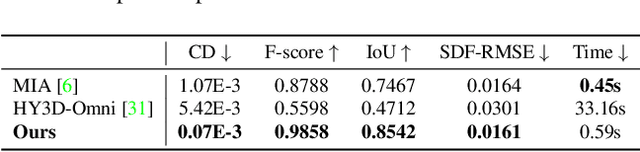
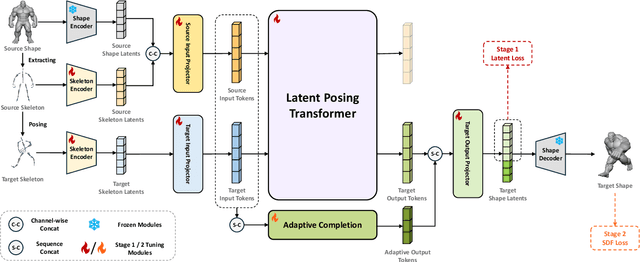
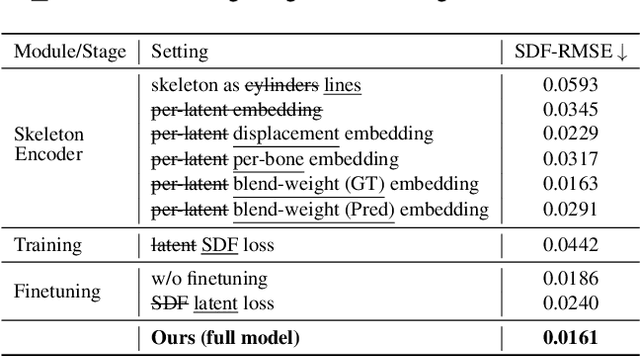
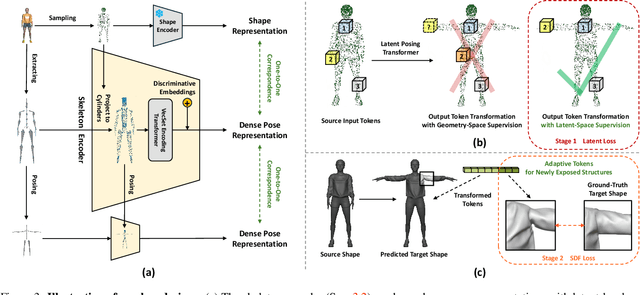
Posing 3D characters is a fundamental task in computer graphics and vision. However, existing methods like auto-rigging and pose-conditioned generation often struggle with challenges such as inaccurate skinning weight prediction, topological imperfections, and poor pose conformance, limiting their robustness and generalizability. To overcome these limitations, we introduce Make-It-Poseable, a novel feed-forward framework that reformulates character posing as a latent-space transformation problem. Instead of deforming mesh vertices as in traditional pipelines, our method reconstructs the character in new poses by directly manipulating its latent representation. At the core of our method is a latent posing transformer that manipulates shape tokens based on skeletal motion. This process is facilitated by a dense pose representation for precise control. To ensure high-fidelity geometry and accommodate topological changes, we also introduce a latent-space supervision strategy and an adaptive completion module. Our method demonstrates superior performance in posing quality. It also naturally extends to 3D editing applications like part replacement and refinement.
Crab: A Unified Audio-Visual Scene Understanding Model with Explicit Cooperation
Mar 17, 2025In recent years, numerous tasks have been proposed to encourage model to develop specified capability in understanding audio-visual scene, primarily categorized into temporal localization, spatial localization, spatio-temporal reasoning, and pixel-level understanding. Instead, human possesses a unified understanding ability for diversified tasks. Therefore, designing an audio-visual model with general capability to unify these tasks is of great value. However, simply joint training for all tasks can lead to interference due to the heterogeneity of audiovisual data and complex relationship among tasks. We argue that this problem can be solved through explicit cooperation among tasks. To achieve this goal, we propose a unified learning method which achieves explicit inter-task cooperation from both the perspectives of data and model thoroughly. Specifically, considering the labels of existing datasets are simple words, we carefully refine these datasets and construct an Audio-Visual Unified Instruction-tuning dataset with Explicit reasoning process (AV-UIE), which clarifies the cooperative relationship among tasks. Subsequently, to facilitate concrete cooperation in learning stage, an interaction-aware LoRA structure with multiple LoRA heads is designed to learn different aspects of audiovisual data interaction. By unifying the explicit cooperation across the data and model aspect, our method not only surpasses existing unified audio-visual model on multiple tasks, but also outperforms most specialized models for certain tasks. Furthermore, we also visualize the process of explicit cooperation and surprisingly find that each LoRA head has certain audio-visual understanding ability. Code and dataset: https://github.com/GeWu-Lab/Crab
Dragen3D: Multiview Geometry Consistent 3D Gaussian Generation with Drag-Based Control
Feb 23, 2025Single-image 3D generation has emerged as a prominent research topic, playing a vital role in virtual reality, 3D modeling, and digital content creation. However, existing methods face challenges such as a lack of multi-view geometric consistency and limited controllability during the generation process, which significantly restrict their usability. % To tackle these challenges, we introduce Dragen3D, a novel approach that achieves geometrically consistent and controllable 3D generation leveraging 3D Gaussian Splatting (3DGS). We introduce the Anchor-Gaussian Variational Autoencoder (Anchor-GS VAE), which encodes a point cloud and a single image into anchor latents and decode these latents into 3DGS, enabling efficient latent-space generation. To enable multi-view geometry consistent and controllable generation, we propose a Seed-Point-Driven strategy: first generate sparse seed points as a coarse geometry representation, then map them to anchor latents via the Seed-Anchor Mapping Module. Geometric consistency is ensured by the easily learned sparse seed points, and users can intuitively drag the seed points to deform the final 3DGS geometry, with changes propagated through the anchor latents. To the best of our knowledge, we are the first to achieve geometrically controllable 3D Gaussian generation and editing without relying on 2D diffusion priors, delivering comparable 3D generation quality to state-of-the-art methods.